
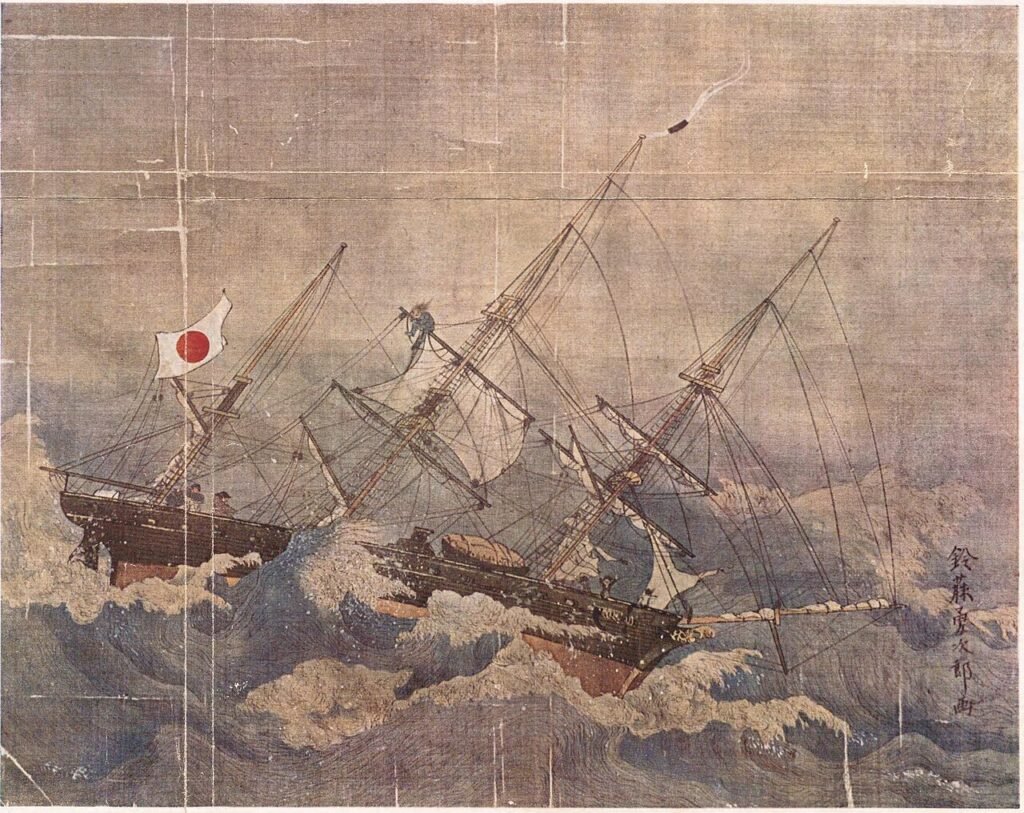
Artwork of the Japanese warship Kanrin Maru en route to the United States. Suzufuji Yujiro, ca. 1860.
The North Pacific. Winter, 1860. Wave after wave batters the small steam corvette Kanrin-Maru. The ship heaves over thirty-five degrees between port and starboard.
On top of the storm, the supply of water has run low. A man in captain’s clothes paces without word on the deck, his boots digging into its wooden boards. Five American sailors kneel before him. Ninety-six Japanese sailors watch them silently.
The pacing man stops. After a moment, he roars.
“You may shoot any seaman found wasting water. Any such person is guilty of treason to the ship. No admonition or inquiry is necessary. You may feel free to shoot him at once.”
Such were the conditions of the ship that brought the twenty-five year old Japanese interpreter Fukuzawa Yukichi to the United States.
When I came to Japan, I boarded United Airlines Flight 803 direct from Washington Dulles International Airport in Loudoun County, Virginia. I spent the flight:
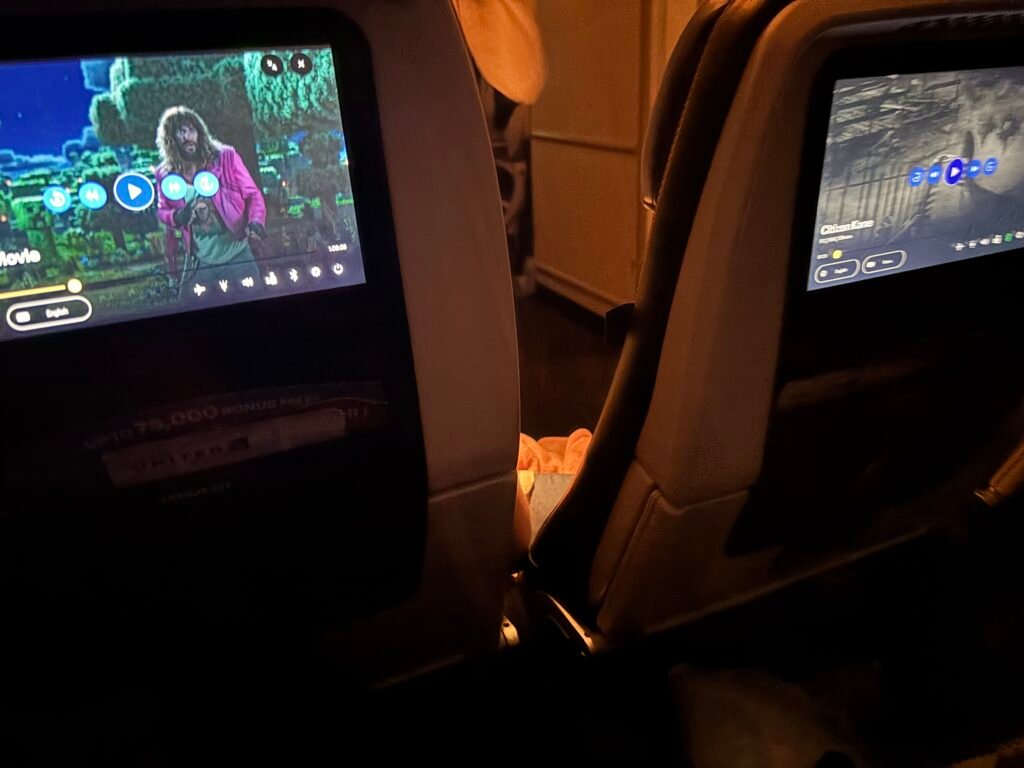
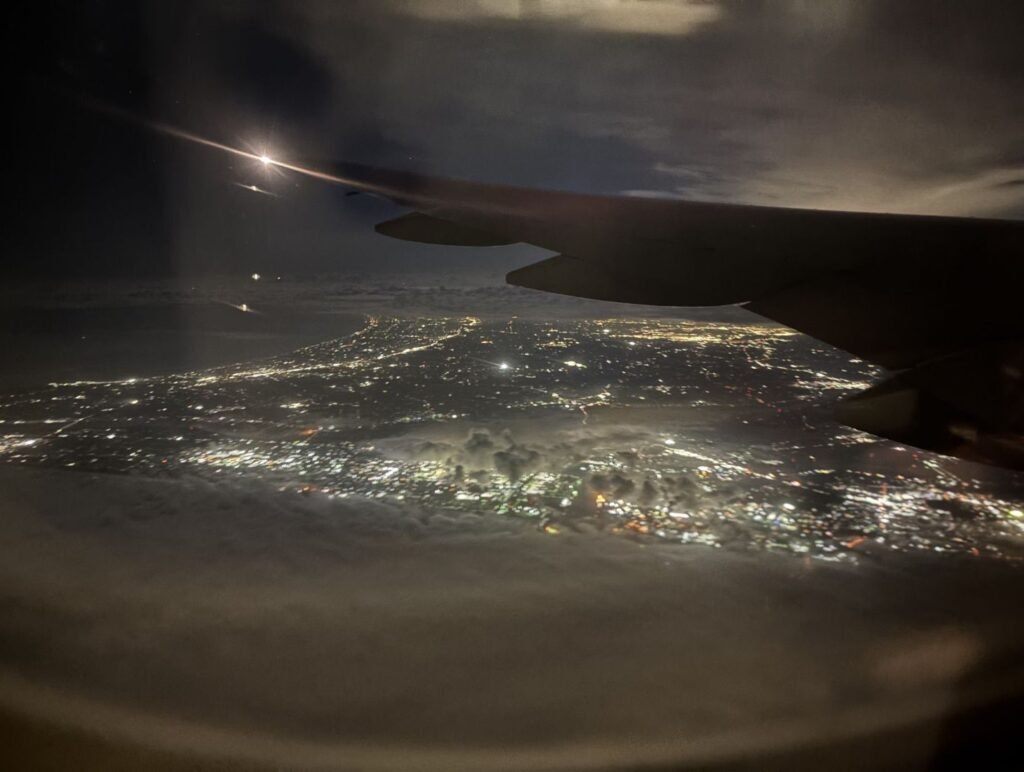
Needless to say my travel experience in the opposite direction proved a little different. And, unfortunately, despite crossing the Pacific ocean in just over 24 hours at an average cruising speed of 880 kph, I also arrived about 165 years—give or take a few months—too late to meet this Mr. Fukuzawa Yukichi as he departed for America.
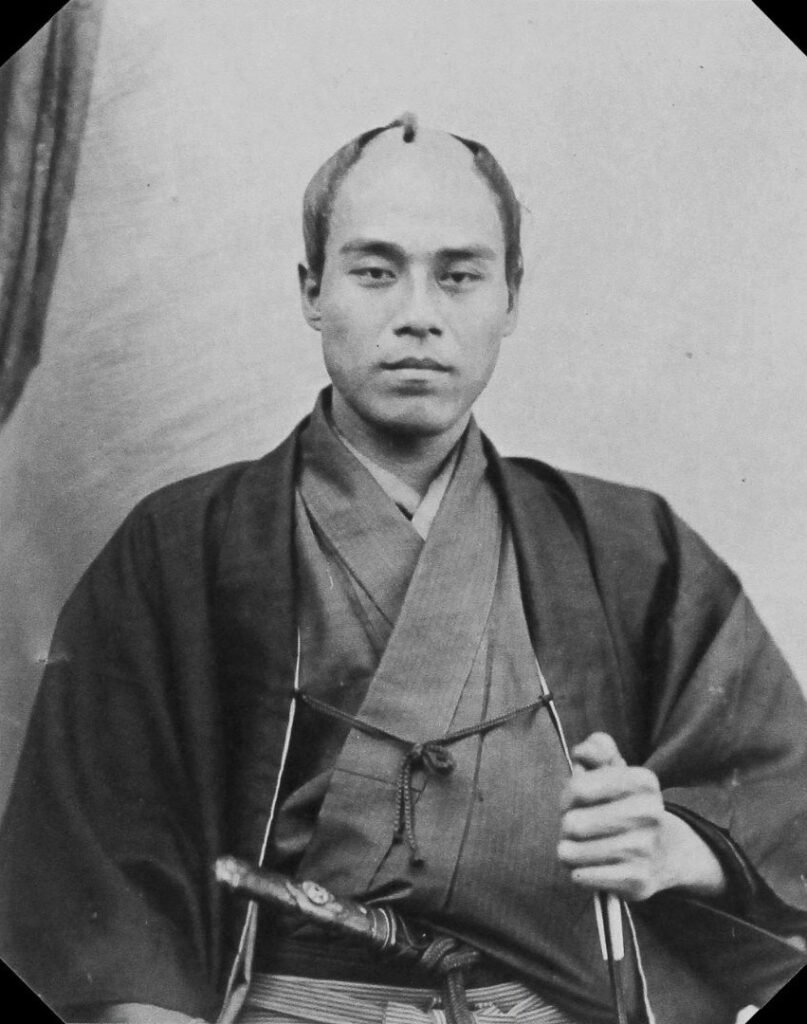
Fukuzawa Yukichi, age 27 (taken two years after his departure), and John Matuszewski, age 22. Maybe you can guess who is who?
Yukichi served as an interpreter for Kimura Kaishū, the commander of the 1860 Japanese embassy to the United States. The mission marked Japan’s first sanctioned overseas journey following the end of the Tokugawa shogunate’s sakoku, or “locked country,” foreign policy. At the time, Japan knew almost nothing about the wider world beyond scattered reports from foreign traders and a handful of imported books—accounts from lands so distant and uncontacted that they might as well have come from a “distant galaxy,” to borrow the phrase of Kume Kunitake, chronicler of a later diplomatic mission in 1872.
As I’ve teased, the voyage itself nearly ended in disaster. Midway between Hawaii and California, the embassy’s transport ship came close to running out of fresh water. Fortunately, strict rationing allowed the remaining supply to last until the ship reached San Francisco, and the mission continued without serious danger. The delegation went on to tour San Francisco, Washington, DC, and New York before returning to Japan. Throughout the journey, Yukichi carefully documented his experiences.
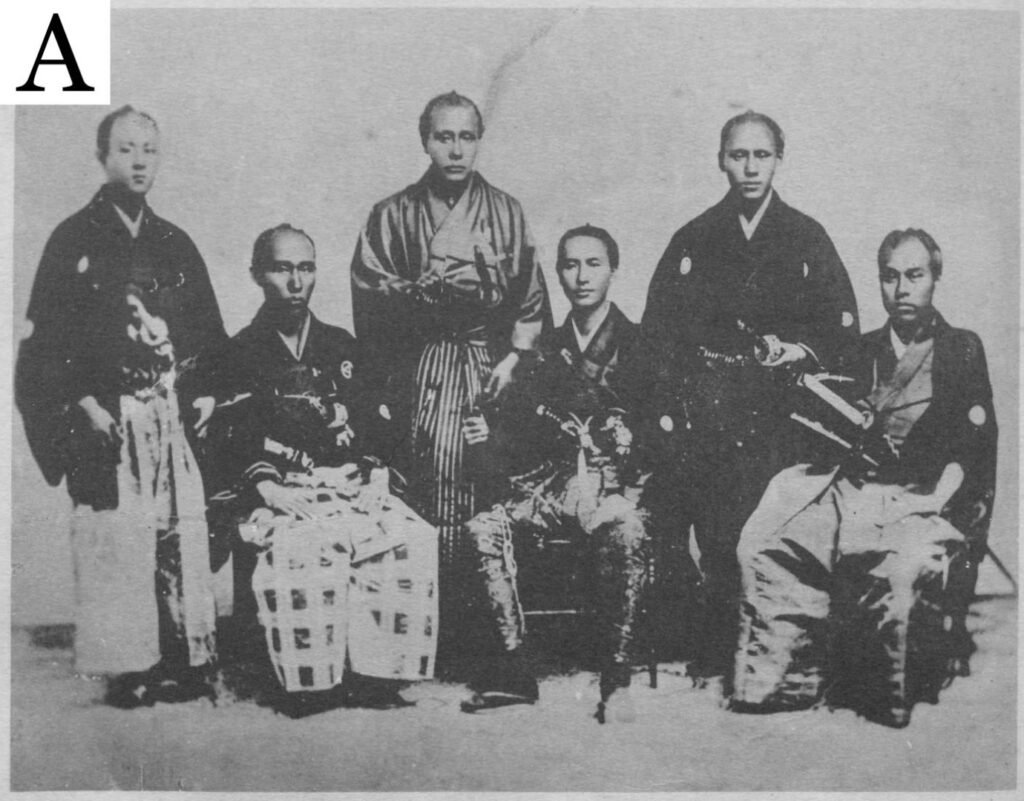
A: 1860 photo of the Kanrin Maru crew in San Francisco. Fukuzawa Yukichi is on the far right.
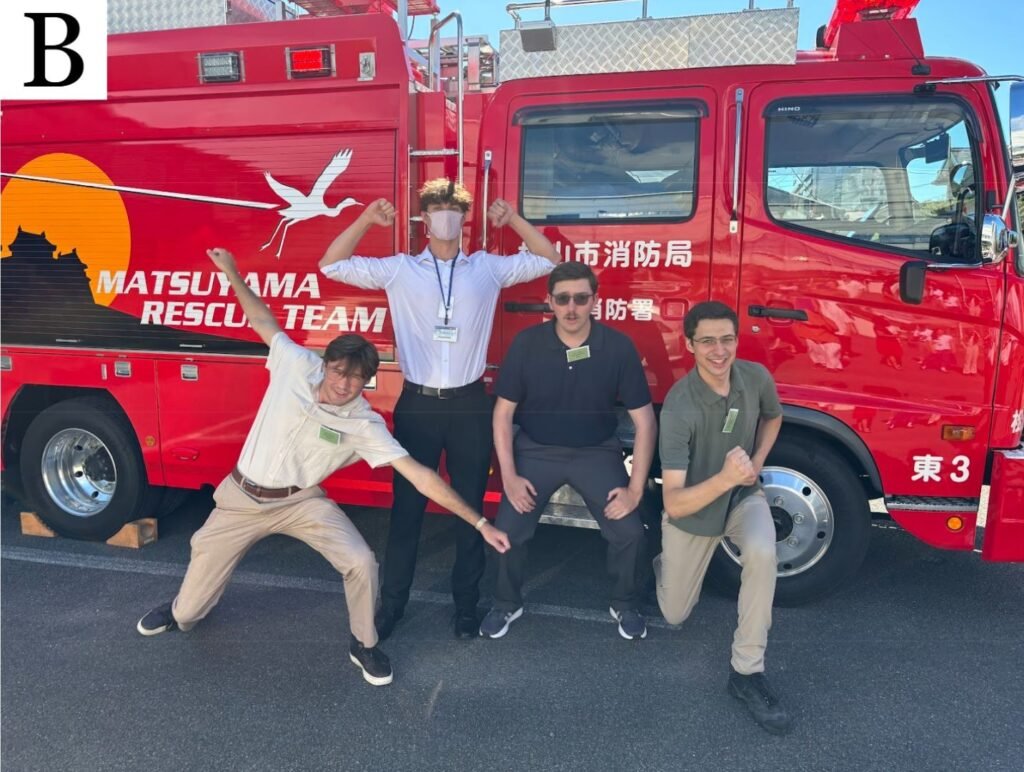
B: 2025 photo of the incoming JET cohort of 2025. John Matuszewski is on the far right.
Several decades later, he wrote an account of his experience in an autobiography. It was this autobiography that I stumbled upon one afternoon during my lunch break. I was hooked. I read the entire thing within a few days, and it inspired me to share his story with my fellow expats here in Japan.
Despite the differences of time, space, and culture, I am struck by how similar our lives feel, and so rarely, if ever, have I felt as strong a connection with a character of our shared human history as I have found in the story of Mr. Fukuzawa Yukichi.
So, join me on a trip into the pages of history, back in time and across space into the universal experience of being a stranger in a strange land.
Welcome to The Autobiography of Fukuzawa Yukichi.
Our hosts in San Francisco were very considerate in showing us examples of modern industry. There was as yet no railway laid to the city, nor was there any electric light in use. But the telegraph system and also Galvani’s electroplating were already in use. Then we were taken to a sugar refinery and had the principle of the operation explained to us quite minutely. I am sure that our hosts thought they were showing us something entirely new, naturally looking for our surprise at each new device of modern engineering. But on the contrary, there was really nothing new, at least to me. I knew the principle of the telegraphy even if I had not seen the actual machine before; I knew that sugar was bleached by straining the solution with bone-black, and that in boiling down the solution, the vacuum was used to better effect than heat. I had been studying nothing else but such scientific principles ever since I had entered Ogata’s school…
As for scientific inventions and industrial machinery, there was no great novelty in them for me. It was rather in matters of life and social custom and ways of thinking that I found myself at a loss in America.
Reading this passage, I agreed with Yukichi completely. I had read extensively about Japan before arriving here, just like Yukichi had read about America, so I was familiar with the shinkansen, ubiquitous vending machines, konbinis, and the like. Some tech still amazed me, obviously. For instance, I remember staring fixedly at a robotic wheelchair piloting itself through the terminal at Haneda airport.
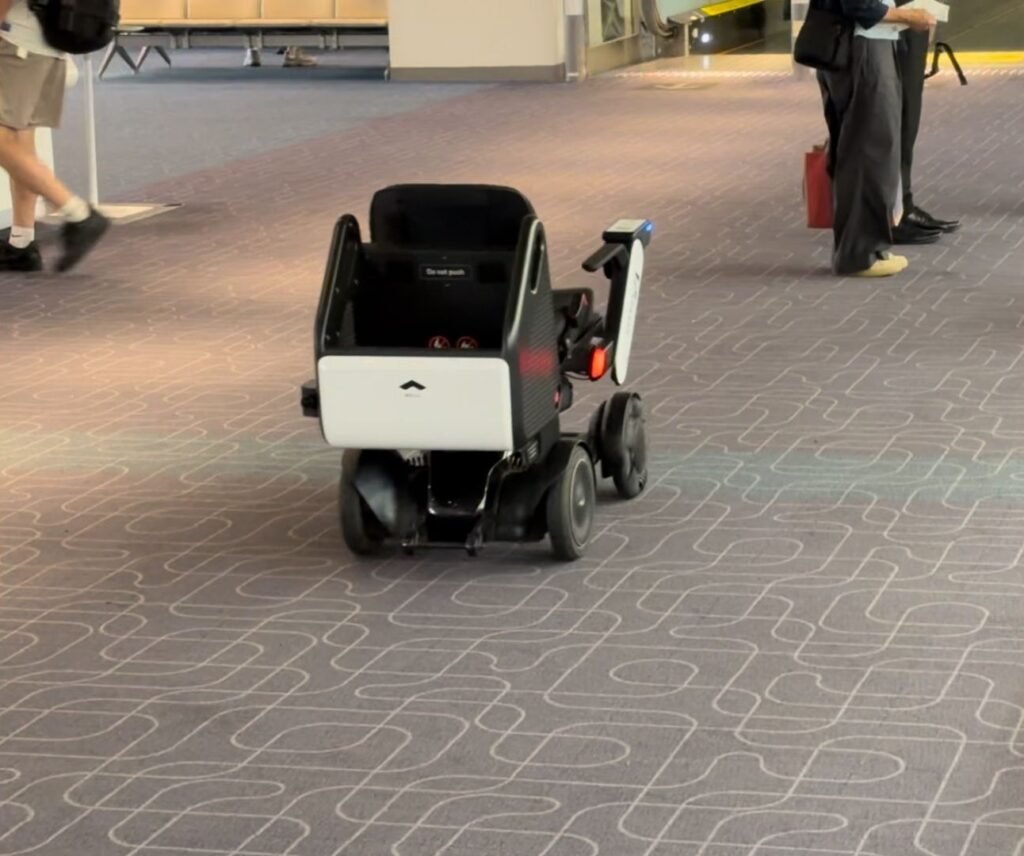
The future is now.
Still, I found that small cultural elements surprised me more often. For instance, as I marked in my journal:
8/30/25: I’m taking a train to Ozu today. While waiting on a platform, another train pulled away. All the uniformed attendants in the cars waved goodbye out the window to the people in the platform. I’ve never seen anything like that in the States.
9/2/25: Today, I went to school. I passed by many little kids walking to school. Each wears an identical little yellow hat. Walking in a line, they all look like little ducklings.
But, just because culture surprised me more often, didn’t mean tech didn’t surprise me with greater intensity. Oddly enough, the biggest technological surprise was not how advanced things were, but how much older technology remained in everyday use.
Today, in my office, I hear fax machine handshake tones, listen to people talk on landline telephones, and watch people mark an attendance booklet with their own personal stamp, the “hanko.” If you live in Japan you’re already familiar with this cigar-shaped stamp that acts as your official signature for bank documents, government paperwork, and attendance sheets. I had known about it before coming here, but it was the amount of paperwork that it was used on that shocked me.
8/19/25: I went to do more orientation stuff at the Board of Education. This was pretty long. The one interesting thing was seeing [XXX]-sensei hold up a form. It was a request to send an email to the ALTs [Assistant Language Teachers]. I had remembered getting that email; it was only about 5 lines long. It had 14 hanko stamps on it, each from someone at the Board of Education who had to physically inspect the printed email and approve of it. There are no digital hankos like there are digital signatures in the US.
It’s also strange to live in such a cash-based society. Approximately 60% of all consumer transactions that take place here are in cash, as opposed to 16% in the United States. I’ve never seen so many armoured cars in my life, not because Japan is especially dangerous, but simply because so much physical paper and coin changes hands each day that I imagine the percentage of people who work physically moving it around is miles higher than in the US.
As much as the use of antiquated technology frustrates me sometimes, I like the retro style of old tech. It can be fun to see restaurant owners using CD players for atmosphere or to receive a physical ticket for a train like I’m an interwar era detective in an Agatha Christie novel. And for anyone who loves old technology, Japan can feel like a treasure trove. Retro hardware that’s rare or expensive in the United States is easy to find in secondhand shops here. Old Atari and Sega cartridges sit casually on store shelves. Sony even continued servicing PlayStation 2 consoles in Japan until 2018—eighteen years after the system first launched.
I was surprised at the high cost of daily commodities in California. We had to pay a half-dollar for a bottle of oysters, and there were only twenty or thirty in the bottle at that. In Japan the price of so many would be only a cent or two.
Thanks to the weak value of Japan’s currency, I enjoy the opposite situation. Although I earn yen, I still find my basic expenses to constitute a much smaller percentage of my income than in the United States.
Still, certain imported products, like specialty cheese varieties, prove more expensive. Fruits on average appear pricy, because Japan focuses the majority of its fruit industry into the production of specialty fruits that are sold at exorbitant prices, but cheaper fruit can be found if you know where to look. Other industries that are more subsidized in the United States or too niche to induce the effects of economies of scale also prove more expensive in Japan.
Surprisingly, for a land so famous for its domestically-designed hardware, I find that most consumer electronics are more expensive. As far as I can tell, this is due to Japanese tariffs on Chinese-manufactured electronics that compete with domestic brands, currency depreciation, and a less direct distribution system. The opposite is true for my friends from the United Kingdom.
The last obvious note is the cheap healthcare I now enjoy. I was amazed that my last dental appointment only cost $22 USD, even factoring in insurance.
One evening our host said that some ladies and gentlemen were having a dancing party and that they would be glad to have us attend it. We went. To our dismay we could not make out what they were doing. The ladies and gentle-men seemed to be hopping about the room together. As funny as it was, we knew it would be rude to laugh, and we controlled our expressions with difficulty as the dancing went on. These were but a few of the instances of our bewilderment at the strange customs of American society.
Like Yukichi, I often witness cultural elements I find funny but I can’t laugh at because I don’t want to be rude. Since there are so few foreigners in my city, fewer tourists, and few opportunities for international exchange for Japanese people, I pressure myself to present my country—and foreign countries as a whole, often lumped together as if following a shared set of global characteristics—positively.
Unfortunately, the Japanese fashion industry must have heard about my effort and considered it a challenge to break me. In Japan, English text is fashionable to slap on a shirt or cap, but for a country with a population-wide English proficiency index below that of Afghanistan, this unfortunately doesn’t usually bode well.
I can’t count how many times I’ve stopped mid-sentence in the middle of a lesson, stunned by the initial observation of an unintentionally humorous hoodie or backpack. I’ve gotten used to some of the big names by now. Rat Effect is a brand popular among boys, and Playboy—yes, that Playboy—among girls. Still, new surprises appear every week. At this point, every trip out on the town feels like I’m on a safari, exploring for a new specimen to note in my wildlife log. Some of my favorites I’ve jotted down so far include:
As I noted in my diary:
2/24/26: I saw a mother walking with her child. The back of her shirt said,
FUCKIN
EYE
PATCH
Every night I pray to God none of these apparel brands hire an English translator. That would be the safari analogy equivalent of building an open-pit cobalt mine in the middle of Serengeti National Park. Part of me even hopes Japanese people never learn enough English to demand more accurate translations on their clothing, such is the power of their entertainment value.

F.A.T.
As we were unfamiliar with Western life and customs, there was naturally no end of farcical situations occurring among our party. A servant brought sugar when ordered to go for cigars. Our doctor of Chinese medicine had intended to buy some powdered carrot, but instead he had come away with ginger, as he found later.
A few months into my new life in Japan I was suddenly overcome with the urge to consume canned beans.
I dreamed of stuffing black beans, lima beans, chickpeas, kidney beans, baked beans, or any other legume I could find into my mouth. I searched two or three different grocery stores over the next week, asking different staff members if they had canned beans, to their great confusion. I was eventually pointed to so-called “salad beans,” a small 100 gram packet of mixed legumes, which did not satisfy me.
At last, I found what I was looking for: a wide can of delectable kidney beans. I bought it without hesitation and brought it home, looking forward to digging in.
When I got back to my apartment, I realized I didn’t own a can opener.
For the next week I was too busy to go shopping again, so the can sat untouched on my counter while I fantasized about the glorious moment when I would finally open it.
Eventually, the weekend came again, and with my newly bought can opener, I was ready to dig in. After two weeks of waiting, I peeled off a corner of the lid, grabbed a spoon, and eagerly dug in.
The beans were sweet.
Sweet?! Who in the good name of beans would ever sweeten a perfectly good legume? As it turned out, in my rush to buy the beans, I never read the label. It would have told me that I was buying sweetened adzuki beans, a staple of many a dessert in Japanese cuisine. I sat forlorn and alone in my apartment, utterly defeated.
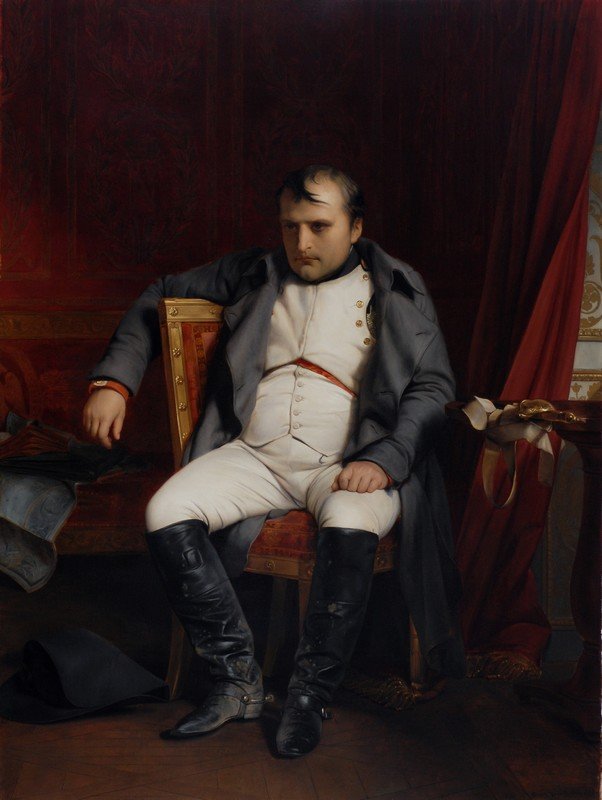
Unrelated photo of Napoleon I at Fontainebleau on March 31, 1814 by Paul Delaroche.
Eventually, I found a small can of black beans being sold for ¥600 in a specialty grocery store, but at that point I couldn’t be bothered to pay almost 4 dollars for a can that would have cost 99¢ in the U.S.
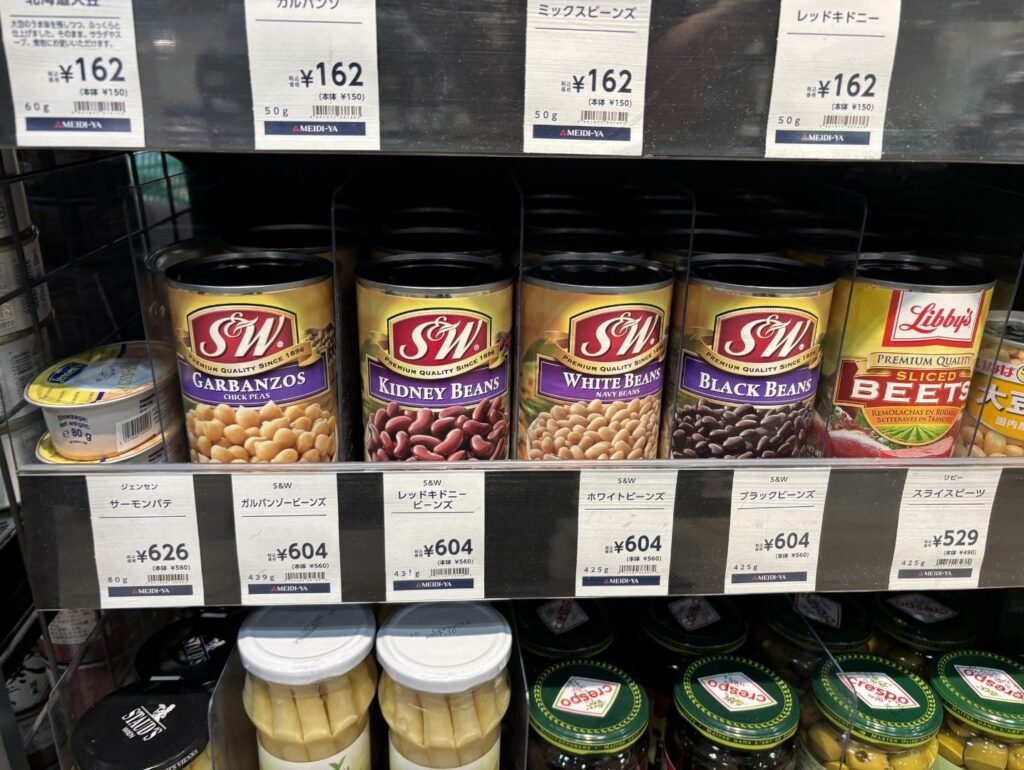
Shenanigans abound.
I wanted to have a smoke, but seeing no “tobacco tray” such as in Japan is placed before the smoker to hold the burning charcoal brazier and the bamboo ash-receiver, I took a light from the open fireplace. Perhaps there was an ashtray and a box of matches on the table, but I did not recognize them as such. I finished my smoke, but finding no ash receiver, I took out some of the tissue paper which we carry in place of handkerchiefs, and wrapping the ashes in it, crushed them very carefully, and placed the ball in my sleeve. After a while I took out the paper to have another smoke; some wisps of smoke were trickling from my sleeve. The light that I thought I had crushed out was quietly setting me afire!
After all these embarrassing incidents, I thought I could well sympathize with the Japanese bride. Her new family welcome[s] her and do[es] everything to make her comfortable. One laughs with her; another engages her in conversation—all happy with the new addition to the family. In the midst of all this the bride has to sit trying to look pleasant, but in her efforts she goes on making mistakes and blushes every time.
Before leaving Japan, I, the independent soul—a care-free student who could look the world in the face—had feared nothing. But on arriving in America, I was turned suddenly into a shy, selfconscious, blushing “bride.” The contrast was indeed funny, even to myself.
I was a shy kid. It took years of practicing my speaking skills and trying to challenge myself, but by college I felt like I had finally burst out of my introverted teenage bubble and became my most confident self. I finally felt proud of my identity and sure in my abilities.
Of all my skills, I thought my strongest was my command of my voice. During the summer of sophomore year, I hosted a radio show at a station near my workplace. By my senior year, group project members consistently asked me to play the central role in any presentation. I often struck up conversations with strangers around town and felt I could talk with anyone without fear. Finally, in my last semester of university, I hosted an auction for my university in front of six hundred people, and a month later performed stand-up comedy before a crowd of seven hundred. By that point, I felt no fear of public speaking whatsoever.
When I arrived in Japan, however, all of that effort to improve my speaking skills had flown out the window. Suddenly, my greatest strength was meaningless. I had a greater chance of communicating what I wanted with hand gestures I had seen chimps mimic on TV than with a punchline that landed at the right moment or a compliment delivered with impeccable timing.
Of course, I knew this would happen when I accepted a job in Japan. I came to challenge myself. But knowing something intellectually and experiencing it personally are very different things.
People around me who had difficulty communicating with me were, of course, very pleasant and extremely cordial. But, I could not help feeling shy. I didn’t know how to tell people how much their kindness meant to me, or explain what I wanted, or why I was correct, or even ask how they were feeling. To lose the ability to show my empathy felt, in no small exaggeration, disabling.
I responded to this newfound inability in two ways. Firstly, I viewed my skill with the English language almost as a crutch that I had taken for granted. I was more grateful than ever during the few times when I could speak in English with my native accent and speed. Secondly, I resolved to learn more Japanese. My communication problem was mine to endure, but also mine to solve. I would never be as good at Japanese as I was in English, but I took a page from the stoics and decided to dedicate myself to its study.
Months after my arrival, I have reclaimed some of my former linguistic glory, but there is still a lifetime of knowledge left to learn. Thus the challenge never ends, and with it, the feeling of progress that makes life worth living.
I have already described the generosity of our hosts and the people in San Francisco. Not only did they repair the damaged parts of our vessel, but they were thoughtful enough to build lockers in convenient places on board for the use of the crew. When the ship was ready and we were preparing to sail on the homeward voyage, we inquired how much we should have to pay for the repair of our ship and other expenses. We were met with a kindly smile. And we were obliged to sail away with our obligations unpaid.
As much as I am frustrated with many aspects of expat life, I am always surprised by the generosity of kindly strangers who want nothing more than to help. I have attempted to pay for glasses repair and cellular plan assistance without success from helpful shopkeepers. At dinner with Japanese friends, all my efforts to contribute money for at least my part of the meal is wasted. Local restaurateurs offer unexpected free appetizers grown from their garden, and people in general are quick to assist and, for the most part, understanding.
I remember walking with my friend in Nara prefecture when all of a sudden a car stopped on the road in front of us. A woman jumped out of the driver’s seat and asked us to stop what we were doing. My friend and I looked at each other confusedly while the woman opened her trunk. Soon enough, two fresh persimmons were in our hands to enjoy. We thanked the woman profusely and she drove off. Just like so often happens in this country, I walked away without fully understanding what had just happened, but I felt grateful all the same.
Fukuzawa sailed away from San Francisco with his ship repair debts unpaid. In a much smaller way, I often feel the same. I often wonder how I might someday repay the kindness so many have shown me. Yet the more generosity I encounter, the more Sisyphean the task seems to become.
It was as we sailed away from Hawaii that I caused a little stir among the young men of our crew. As I have heretofore admitted, I am naturally free from amorous ties, nor would I allow myself to join in gossip on such affairs. So some of the men of our ship regarded me as a rather strange kind of human. But on the day we sailed from Hawaii, I produced a photograph and showed it to my companions on board. Here it is!
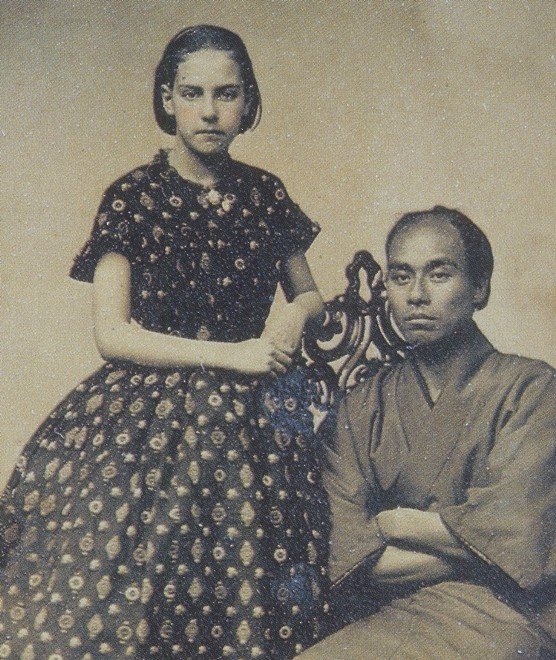
What do you think of it?
Now, none of the men could tell just what the girl really might have been—whether a daughter of a respectable family or a girl of the streets or a professional entertainer. “You all talk a lot about your affairs,” I said, chiding the surprised seamen. “But how many of you have brought back a picture of yourselves with a young lady as a souvenir of San Francisco? Without any evidence, what good is it to boast of your affairs now?”
The girl was really the daughter of the photographer; she was fifteen, as I remember hearing. On the day I went to the photographer’s, where on a previous day we had been for some pictures, it was raining, and I went all alone. As I was going to sit, I saw the girl in the studio. I said suddenly, “Let us have our picture taken together.” She immediately said, “All right,” being an American girl and thinking nothing of it. So she came and stood by me.
You may be sure the young officers of the Kanrin-maru were taken aback. Some of them showed extreme envy, but all too late. I knew that if I had showed my photograph in San Francisco, many would have followed my trick, so I kept it unseen until our boat had left Hawaii and there was absolutely no more chance that I produced it. It was the joke of the day on board.
I enjoy showing my students photographs of my life outside of the classroom, just like Yukichi showed pictures of himself to the crewmen. Students and teachers generally enjoy seeing what I’m up to or photos from America, or they’re at least nice enough to pretend it interests them.
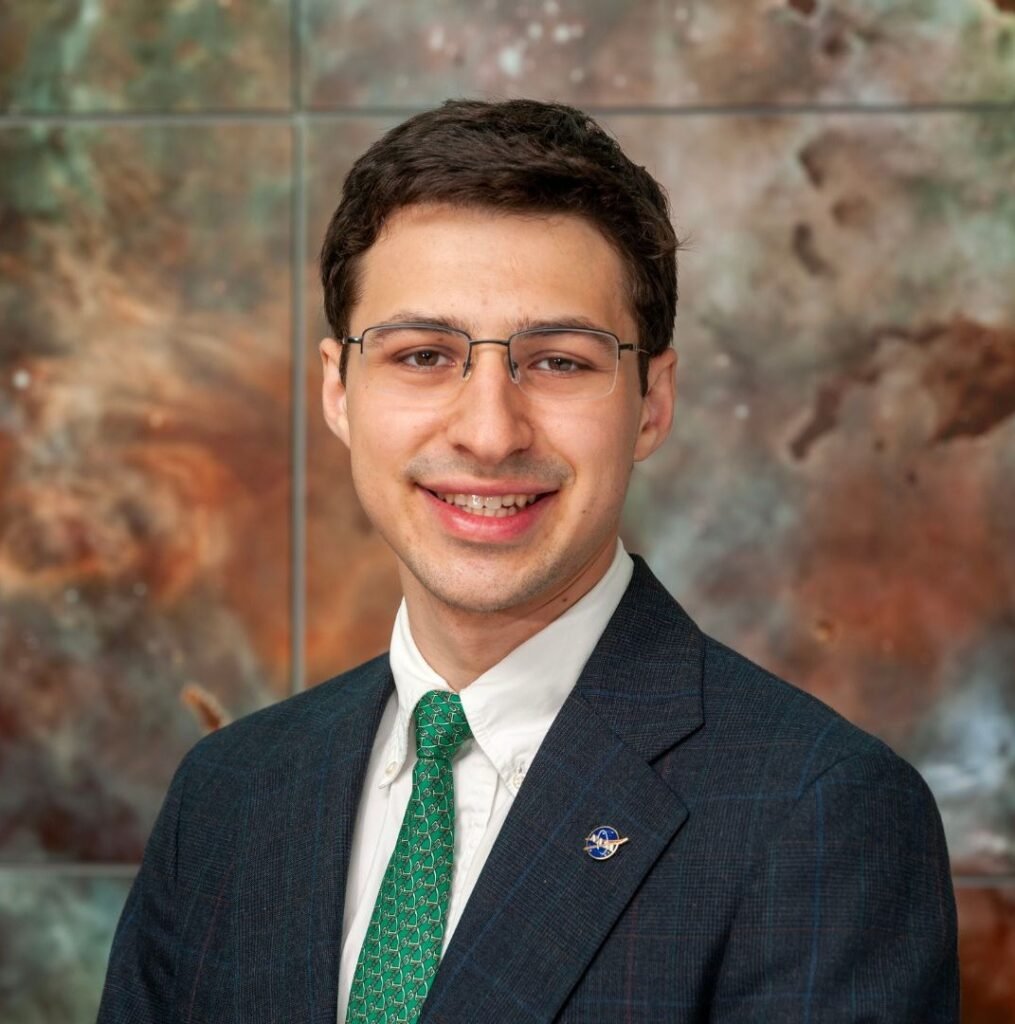
For a presentation introducing myself to my students, I said I used to intern at NASA (this was decidedly less interesting to them than revealing 5 slides later that I like Pokémon). In the presentation, I showed this picture:
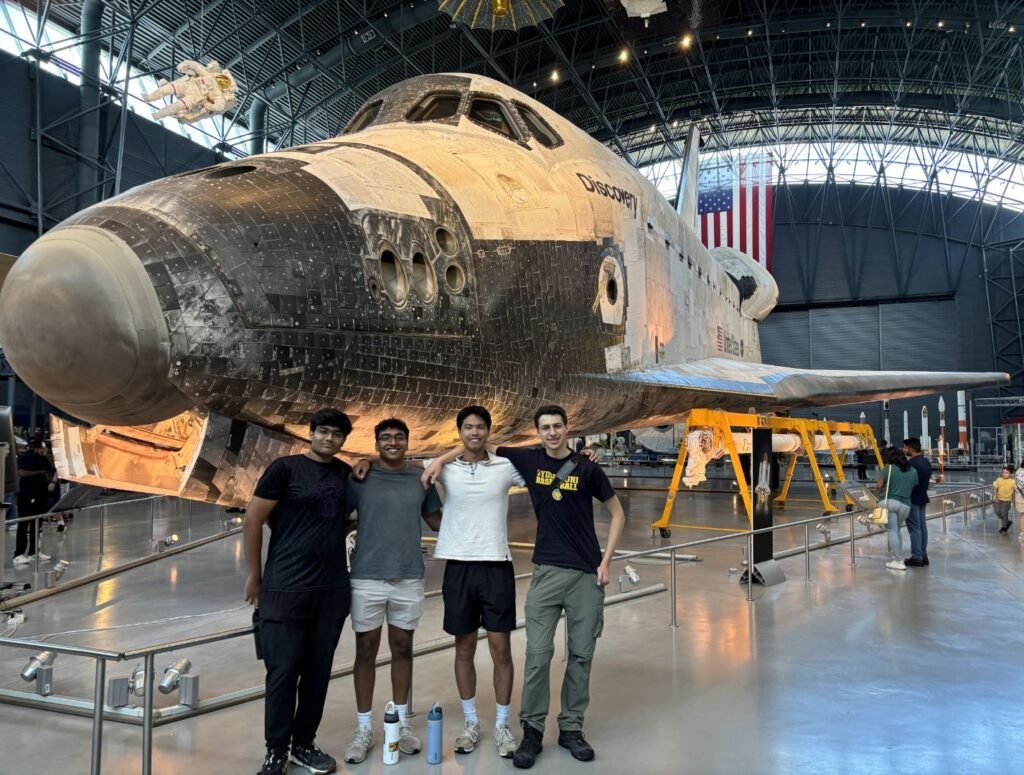
It wasn’t actually taken at my workplace, rather, at the National Air and Space Museum. But, just like Yukichi, I wasn’t going to let the truth get in the way of a good story, so I presented it as if it was from my work. I was feeling rather pleased with my presentation when the class ended.
An hour later, as I was sitting in the teacher’s office, a third grader knocked on the door and asked to see me. I walked over to him with the principal and asked him what he wanted. He said, with complete seriousness, “which space station did you use to live on?”
Though I was taken aback, his question makes more sense now that I know more about my students. I’ve learned that most of my younger students have an extremely poor understanding of basic geography. For instance, I’m often asked if I’m Chinese or Korean. I tell them I’m not either. I keep reminding my students that they don’t need to keep greeting me with “Anyeonghaseyo” and “Ni Hao,” but this has not stopped even months after my arrival at my elementary school.
So, I think when this kid saw me, being probably the first non-Asian person he’d ever interacted with for more than a passing moment, since the previous two English teachers before me were Filipino, having learned from my introduction presentation that I was from a place other than a country he knew, and having seen a picture of me next to a spaceship, he deduced that I was some sort of spaceman.
We’ve reached the end of our journey back in time. I hope you’ve enjoyed learning more about the life of Fukuzawa Yukichi and pray his stories inspire you to learn more about the history of cultural diplomacy between your nation and Japan. It can be easy to think of people of the past as dull, still, monochromatic shadows of an unrecognizable culture and setting. But the truth is, all these historical figures were just like us, with hopes, dreams, tragedies, triumph, and loves. Like us expats today, Fukuzawa Yukichi struggled with language barriers, misunderstood unfamiliar customs, laughed at cultural oddities, and relied on the kindness of strangers.
His world looked very different from ours, but the experience of navigating it was remarkably the same. In that sense, reading Fukuzawa’s autobiography felt less like studying history and more like meeting a fellow traveler.
Thank you for reading!
Hey everyone! Thanks for checking out this month’s article. If there is a story, experience, or idea you’d like to share please reach out to us at themikanblog@gmail.com. We’d love to hear from you!
Best, Justin
