

Zev Green
Zev is a first-year ALT in Iyo City. He hails from the lovely city of Portland, Oregon, and has had a lifelong connection to Japan inherited from his mom, who was an ALT herself some thirty years ago. He attended Japanese immersion elementary school in Portland and has been studying Japanese off-and-on ever since (heavy emphasis on the off, as his Japanese is not great). Zev’s primary interest is cuisine (as documented on his personal food/travel blog, zeveatsit.com), but he also has a burning passion for music, movies, sports, prestige TV, and recreationally reading Wikipedia. He thinks that The Sopranos is the pinnacle of creative fiction, the Grateful Dead are the greatest American rock n’ roll band ever, and Deni Avdija will be an All-Star this season. He has many other strong opinions and enjoys discussing them – if you want to hear more, subscribe to his blog!
I’m no expert on movies. Should I call them movies or films? Film is the more sophisticated of the two, but it feels pretentious. Sometimes I think I’m pretentious – my perception of it vacillates between the occasional shame and self-consciousness, and unabashed acceptance. After all, being pretentious means you have taste. And nothing is more important to me than taste – both figuratively and literally. Perhaps some pictures are movies, and some are films. For instance, Over The Top (1987), an absurd Stallone flick about arm wrestling, is not worthy of the term “film.” But to describe The Battle of Algiers (1966) as a mere “movie” would be wholly insufficient.
But Bugonia, the new picture directed by Yorgos Lanthimos and starring Emma Stone and Jesse Plemons, is absolutely worthy of being called a film. I had heard of Lanthimos because his 2023 film Poor Things was nominated for some heavy-hitting awards at the Oscars, including a Best Actress win for Emma Stone. I’m ashamed to say that I’d never really seen an Emma Stone movie (I’m not counting Superbad (2007) or Zombieland (2009)). Plemons (arguably the Philip Seymour Hoffman of his generation, and not just because he’s ginger), I was a fan of from, among other works, Breaking Bad and Killers of the Flower Moon (2023). Going in, I really knew nothing about this movie.
Two weeks ago, my mom texted me, “U gotta watch Bugonia. Up for Oscar.” My grandma’s review: “Bizarre.” I filed that away and didn’t think twice about it, until I was invited to see it this weekend. I didn’t even know it was getting a Japanese release. However, the person who invited me – whose anonymity I will keep for their safety – wanted to see it at 9:40. Kind of late, you might think, though I’ve been to later. Nope, they meant 9:40 in the morning. What kind of a sick bastard sees a movie before 11 AM (except for the following: if you’re elderly, on a flight, or planning a double feature)?
After choosing a more reasonable time to go to the movies, I was off to the theater. En route, my more knowledgeable friend informed me that it was actually a remake of the Korean cult classic Save the Green Planet! (2003). The director of that movie, Jang Joon-hwan, was originally supposed to direct Bugonia as well, but had to step down for health reasons. Do I have to do a synopsis? All of the other movie reviews seem to. Okay, we’ll keep it brief. Spoilers ahead, obviously. I repeat, spoilers abound.
Emma Stone’s character, Michelle Fuller, is a high-powered CEO of an evil tech-minimalist (think Peter Thiel) pharmaceutical company, on the cover of Time magazine and everything. We see her morning routine in her big fancy house – wearing one of those red light masks, doing intense self-defense training, running on the treadmill with the Bane mask – the whole nine yards. This is contrasted with the routine of Jesse Plemons’s character, Teddy Gatz, and his autistic cousin Don (portrayed by Aidan Delbis in his feature film debut), who live in a broken-down house in a rural backwater town. The Gatzs are poor and have to settle for doing yoga on towels instead of in their personal gym. Teddy is spouting all kinds of conspiracy nonsense about aliens and bee colonies (he’s an apiarist, and the film opens with a close-up of a bee hive and corresponding voiceover), and he convinces Don to let him chemically castrate him in order to better resist the evil alien brain waves. His pseudo-intellectual ramblings contain a grain of truth. Life used to be better, and now it sucks, and this big corporation is to blame – Teddy works for Michelle’s company, sorting and scanning packages.
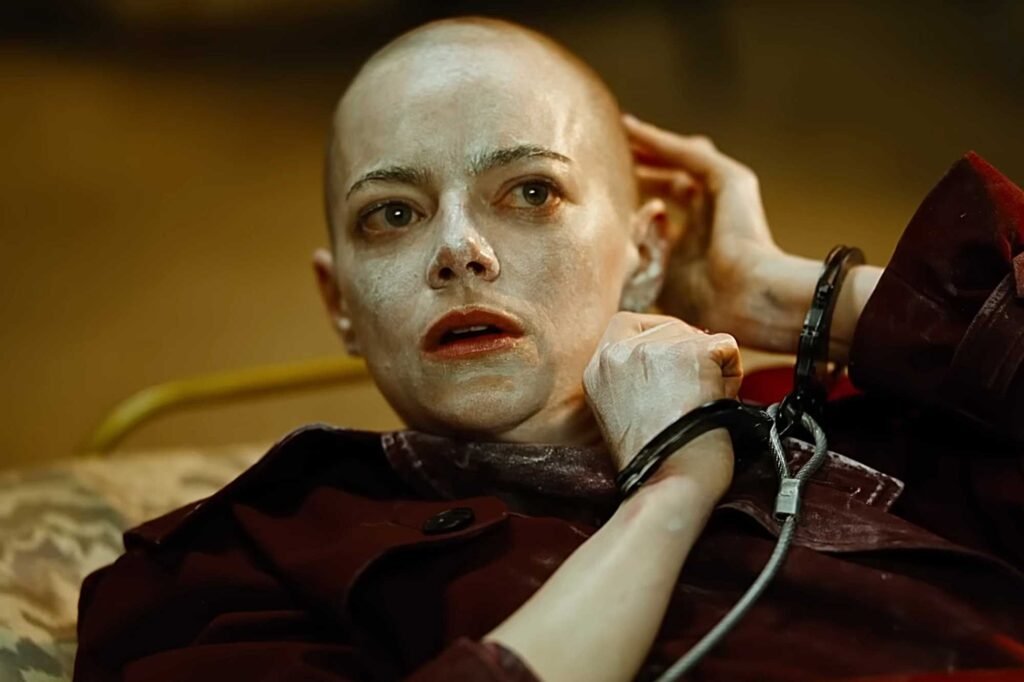
Emma Stone as Michelle Fuller
Teddy hatches a plan to kidnap Michelle in order to parlay with her alien overlords and negotiate the alien withdrawal from Earth, which will, of course, remedy their problems. Somehow, these two doofuses manage to kidnap Michelle, shave her head (so she can’t send messages to her mothership), and imprison her in their basement. She’s shackled to the floor, tortured, and interrogated. We learn that Teddy’s motivation is that Michelle’s company sent his mother into a coma, resulting from clinical trials of a drug intended to ease opioid addiction. When the local sheriff (portrayed by comedian Stavros Halkias), who years ago was Teddy’s babysitter and is implied to have molested him, comes knocking looking for Michelle, the shit hits the fan. Michelle tries to convince Don to free her while Teddy is occupied with the sheriff, but Don ends up pulling a Pvt. Pyle, believing that Michelle will take him to live in outer space. An enraged and desperate Teddy confronts Michelle, who convinces him that the antifreeze in her car is an alien antidote that will cure his mother. While Teddy races off to the hospital to “cure” his mother (obviously, she dies when he injects antifreeze in her IV bag), Michelle manages to free herself from her shackles and explores the basement where she’s been captive, discovering preserved human heads in jars, a gnarly binder of gory photos, and schizophrenic notes and drawings. Michelle learns that she’s just the latest victim of Teddy.
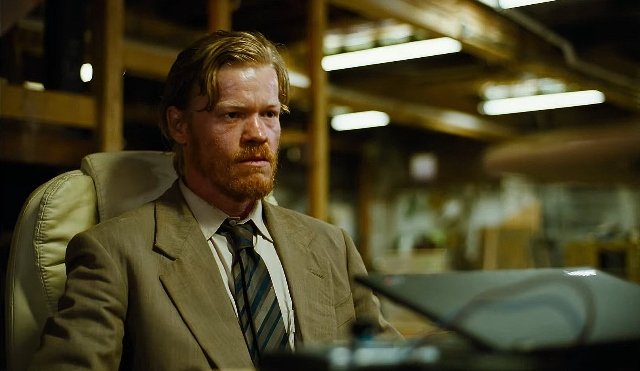
Jesse Plemons as Teddy Gatz
Teddy returns, devastated from having lost his cousin and mother in a matter of minutes. Though he’s equipped with a shotgun and Michelle is unarmed, she browbeats him into submission with a rapid-fire recounting of an alternate alien conspiracy. The aliens have actually been trying to save the humans from their own destructive ways, and have been conducting experiments on select humans to achieve this end (for which Teddy’s mother was a guinea pig). She agrees to set up a meeting between her alien overlords and Teddy, which is what Teddy has wanted all along. They roar off to her office in her G-Wagon, with Don’s bloody corpse in the backseat. When they enter her office – she’s been missing for days, and being a prominent figure, has been the subject of a massive manhunt – Teddy reveals that he’s wearing a homemade suicide bomb vest. Michelle convinces him to enter her closet to teleport to the alien ship, and his vest detonates, decapitating him and knocking Michelle unconscious. She awakens in an ambulance, and – here’s the big twist – flees the ambulance, returns to her office and its active crime scene closet, and actually does transport to the alien ship.
That entire time, you’ve been led to believe that there’s no way Michelle is actually an alien like Teddy says, after all, he’s certifiable. Nope, turns out he was pretty much right about everything. Michelle, the leader of the aliens, who all have long hair and wear big knit onesies, concludes with her alien council that the human experiment has failed, and instantly wipes out the entire human population.
I was really locked into this film. Granted, I love the movies, so I’ll rarely have a bad experience at the movies unless what I’m seeing is actually god-awful. This movie has about three and a half characters and takes place almost entirely in one location. When movies do that – almost like a play – they have the potential to be really boring, if not properly executed. They also have the potential to be great cinema (Glengarry Glen Ross (1992) comes to mind), and this felt like the latter. Stone and Plemons were both exemplary and went toe-to-toe throughout the entire movie (shades of Jamal Murray vs. Donovan Mitchell in the 1st Round of the Bubble 2020 NBA Playoffs). Plemons is at once fully confident in his views, and at the same time desperate – he’s invested his whole life into this twisted project, and the walls are closing in around him. Stone is used to being fully in control, cold and calculating, and when that’s stripped from her, her suffering is intensely human (except, you know, she’s actually an alien). Even while imprisoned by these psychos, she can’t shed her corporate lingo, asking Teddy to “have a dialogue” (I forget if she ever utters the words “circle back” or “put a pin in that”, but I wouldn’t be surprised).
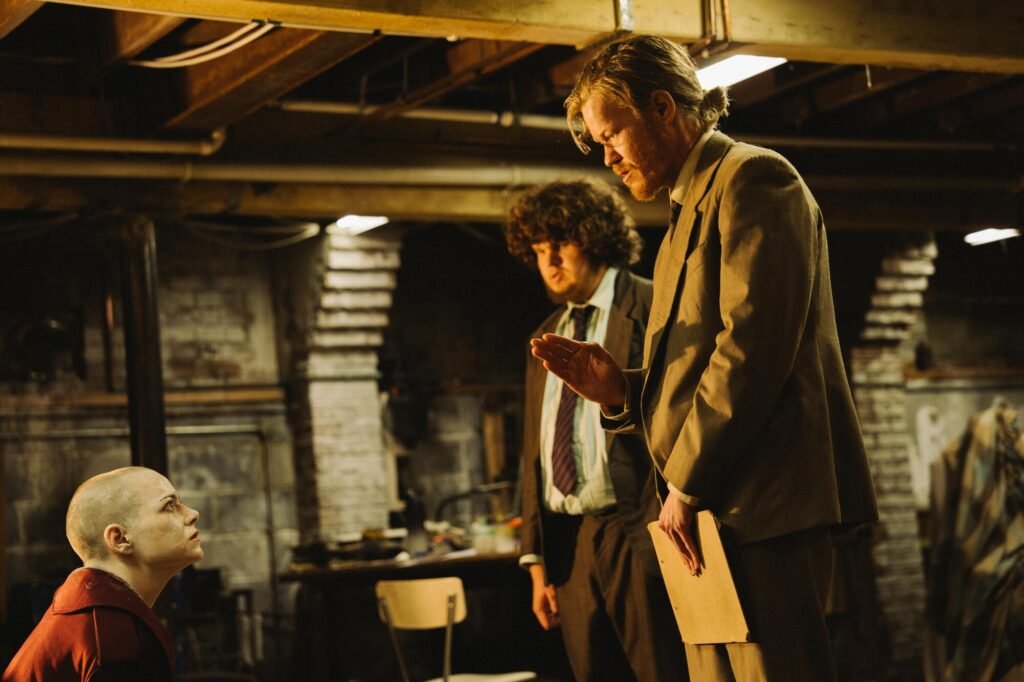
The Gatz’s basement, in which much of the movie takes place
There’s no hero in this movie, only victims. Stone is the most literal victim, shackled to the floor in this psychopath’s Silence of the Lambs-esque basement. But Teddy is a victim too. His mother was taken from him – first by opioid addiction, then by the coma caused by Michelle’s company. His father abandoned their family, and he was molested by his babysitter. All he has left is Don. He’s seen his community get hollowed out, and he sees it as the same problem happening to his precious bees – Colony Collapse Disorder, when the worker bees die and/or abandon the hive, leaving the queen along with her young. It’s an all-too-familiar story in America: a small town left to die. A once-robust local economy crippled by automation, globalization, the Opioid Crisis, you name it. This understandably leaves people feeling isolated, betrayed, and wanting to lash out – Teddy’s actions can’t be justified or excused, but they can be explained. In one particularly intense scene – when Michelle makes a break for it and ends up wrestling with Teddy on the floor – she screams, “You can’t beat me because you are a loser and I’m a winner! And that’s fucking life!” In Michelle’s capitalistic meritocracy worldview, she earned her wealth and status, and Teddy’s misery is a product of his personal shortcomings – he should have pulled himself up by his bootstraps.
You can feel the humidity of the Georgia weather as the cicadas whine and the grime of the blood-soaked basement. The shocking and intense moments – especially Michelle’s torture by electrocution, Don’s suicide, and Michelle’s discovery of Teddy’s perverse collection of corpses – feel like an unholy concoction of Se7en (1995) and Misery (1990), and come through in the stunning shades of VistaVision. That is precisely what made the ending so unsatisfying – compared to the other 95% of the movie, those last few minutes on that goofy spaceship feel like a Super Bowl commercial for, like, Pepsi with Lizzo.
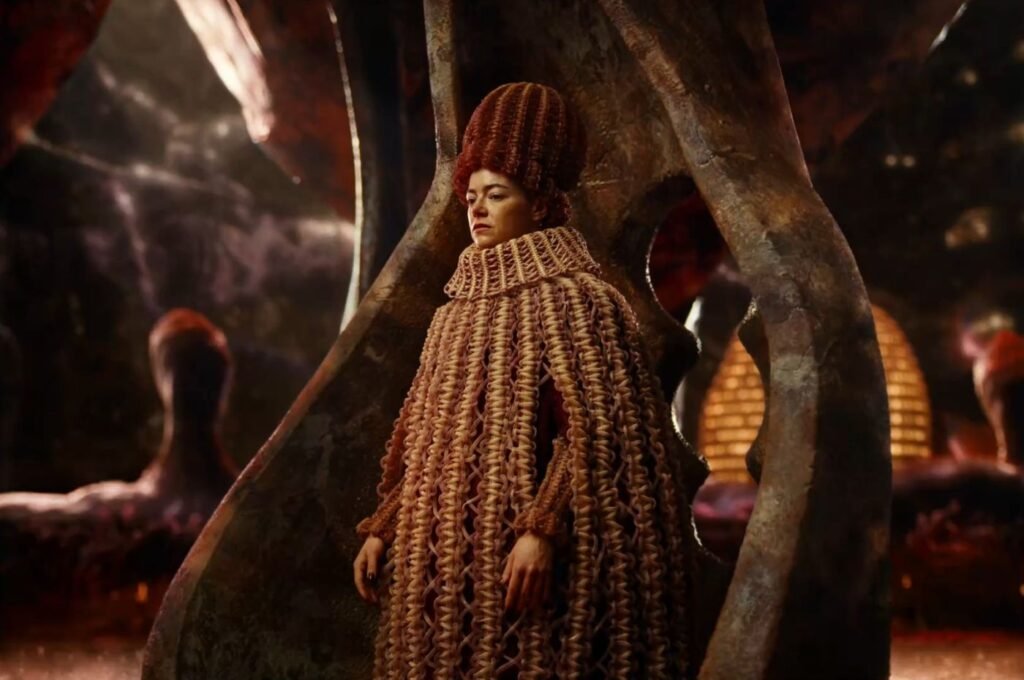
You have to admit, compared to the rest of the movie, this looks pretty silly
It’s interesting that Ari Aster was one of the producers. Before seeing Bugonia, we had been discussing Aster’s most recent film, Eddington, which came out over the summer and was the subject of much scrutiny. Both films are centered around conspiracy theorists – a pertinent topic these days. But like Bugonia, I thought Eddington jumped the shark towards the end with the introduction of the heavily-armed Antifa-style terrorists (a comparison also made by Sean Fennesy of The Ringer on his Big Picture podcast, although I arrived at it independently). Though I was disappointed walking out of Eddington, its on-the-nose satirical portrayal of the turmoil of 2020 has stuck with me after all of these months, and I appreciate that aspect of the film even if the plot takes a strange turn towards the end. Will Tracy wrote the script; his other credentials include The Menu (2022) (heard about it but didn’t see it) and three episodes of Succession. Bugonia, Succession, and other programming, like Severance (haven’t seen it), are all grappling with the theme of corporate evil.
I take umbrage with some of the other reviews published by the big names in news media. David Rooney, writing for The Hollywood Reporter, characterizes Teddy as “crunchy-granola.” While Teddy might agree with some of the things Robert F. Kennedy, Jr., the US Secretary of Health and Human Services, and his MAHA movement might have to say, I don’t think Teddy and Don’s diet – which features frozen taquitos, soda, sugary cereal, and things of that nature – lines up with Rooney’s characterization. Yes, Teddy is concerned about the environment and sports a greasy man-bun, but he’s a far cry from any tree-hugging hippie. Alissa Wilkinson, in her New York Times review, offers a similarly shallow characterization of Michelle as a “girlboss.” The use of girlboss can be genuine, as I believe Wilkinson means it to be, or it can be an irony-laden critique of a type of feminism that champions capitalism, rather than viewing it as an oppressive structure intertwined with the patriarchy. Both Rooney and Wilkinson decline to delve into the politics of the movie, ignoring what seems to me like the obvious class implications of a lowly package sorter kidnapping his CEO, who also is responsible (if not personally, at least nominally) for his mother’s condition.
Owen Gleiberman, for Variety, engages with this theme, but in my humble opinion, he also misses the mark by describing Teddy as “a left-wing nihilistic eco-terrorist conspiracy wingnut, a young man who has soaked up every critique of capitalism and denunciation of corporate-political culture that exists.” Teddy himself tells Michelle, “I ran through the whole digestive tract in… five years? Alt-right, alt-lite, leftist, Marxist. All those stupid badges. I went shopping hungry, and I just bought the whole store.” Defenders of the environment are attributed to the political left, which is understandable. After all, advocating for an economic system that necessitates infinite growth in a world with finite resources is rather incompatible with conservation. But Teddy explicitly tried and rejected a left-wing political ideology. I view Teddy more in line with another eco-terrorist named Ted with a penchant for homemade explosives – Kaczynski, better known as the Unabomber, whose radical pro-nature anti-technology stance and mail-bombing campaign led to the longest manhunt in the history of the FBI. Kaczynski, who hanged himself in prison after abandoning cancer treatment in 2023 at the age of 81, had scathing critiques of both the left and right. Gleiberman also observes that “much of what [Teddy] says about the new global authoritarian corporate culture – the new world disorder – is true,” and invokes the Misery (based on a Stephen King novel, directed by Rob Reiner, and starring James Cann and Kathy Bates) comparison (I also arrived at that independently). Aside from Gleiberman’s wont to label Teddy as a leftist, I appreciate his review. Natalie Keogan for the AV Club provides a more nuanced critique of the film’s underdeveloped message, and brilliantly notes the social role that CEOs play as targets for expressing our displeasure with our late-stage capitalist system, where corporations seem above reproach (and shares my feelings about the term “girlboss”).
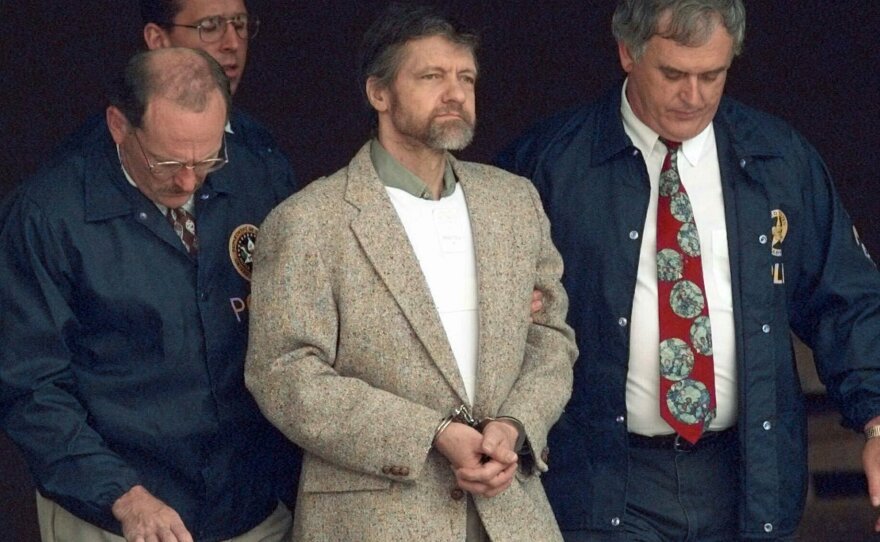
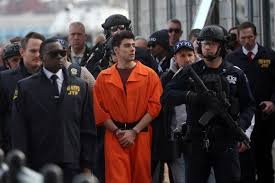
Ted Kaczynski and Luigi Mangione, who used violence against technology advocates and a healthcare CEO, respectively
Ultimately, many of my feelings about Eddington I have about Bugonia. I was enthralled through the vast majority of it. My jaw hung agape, and my palms perspired during intense moments. The score is sweeping, intense, and orchestral. Stone and Plemons (like Joaquin Phoenix and Pedro Pascal in Eddington) are simply sensational. The film is clearly trying to say something. But while the message might be muddled, at the very least, it seeks to portray a dark corner of our society that many would rather pretend does not exist. Aside from the jumbled theme, I had a major issue with the ending. Otherwise, Bugonia is intense, moving, and visually stunning. I gave it ⅘ stars on Letterboxd. It was nominated for four Academy Awards: Best Picture, Stone for Best Actress, Writing (Adapted Screenplay), and Music (Original Score). Shockingly, Plemons was not nominated for Best Actor. While I am unable to properly pass judgment, given that I haven’t seen all the other performances nominated, Plemons’s performance felt Oscar-worthy, in a vacuum. Anyway, if you like gory thrillers like the aforementioned Se7en, Misery, Silence of the Lambs, or even 8mm (1999), you will enjoy seeing Bugonia on the big screen. If you draw the line at severed heads in jars, maybe skip it.
Hey everyone! Thanks for checking out this month’s article. If there is a story, experience, or idea you’d like to share please reach out to us at themikanblog@gmail.com. We’d love to hear from you!
Best, Justin
