
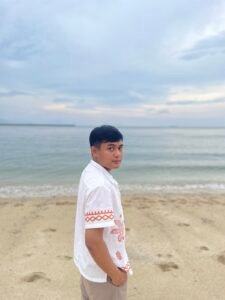
Vince Justin Roland Madriaga
Mabuhay! I’m Vince, from Marinduque – the Heart of the Philippines. Growing up surrounded by the waters and lush landscapes, I inevitably developed a deep-rooted love for tranquil spaces and nature.
As an introvert mastering the art of extroversion, I have found value in connections and beauty in stories. I am not much of a talker, but I’ve always found home in my pen and paper. I wish to share that home with others.
Run Mikyan, Run: Inside the Ehime Marathon 2026
It was a cool Sunday morning, February had just begun, the city wrapped in that indecisive winter air. It was not freezing, but just cold enough to make you question your life choices if you step outside at 8:00 in a 5°C weather.
Still, you do it.
As I made my way from the humble Tachibana area toward the center of Matsuyama, with bobbleheads of my friends in hand, I began noticing more and more people in running shoes, shorts layered over leggings, and the unmistakable ASICS and Onitsuka Tigers that signaled something serious was about to happen.
By the time I reached the heart of the city, the cold had been slowly replaced by warmth, noise, and color. Running gear had transformed into running costumes. There were Minions, Pokémon, and Chiikawa. I am fairly certain I even saw a male version of Elphaba stretching for dear life.
The day was already bursting with personality, and even the familiar gray and green of Shiroyama Park seemed brighter, with all shades of orange.
It was the 63rd Ehime Marathon.
Why Run at All?
The Ehime Marathon is an annual full marathon that gathers around 10,000 runners from across the prefecture. The course begins near the prefectural offices, stretches out toward Hojo, and loops back to Shiroyama Park. It is scenic, yes, but also unapologetically long.
Among this year’s runners were three ALTs: James Moriarty, Oscar Keavney, and Topman Roberts, each taking on the full 42.195 km challenge.
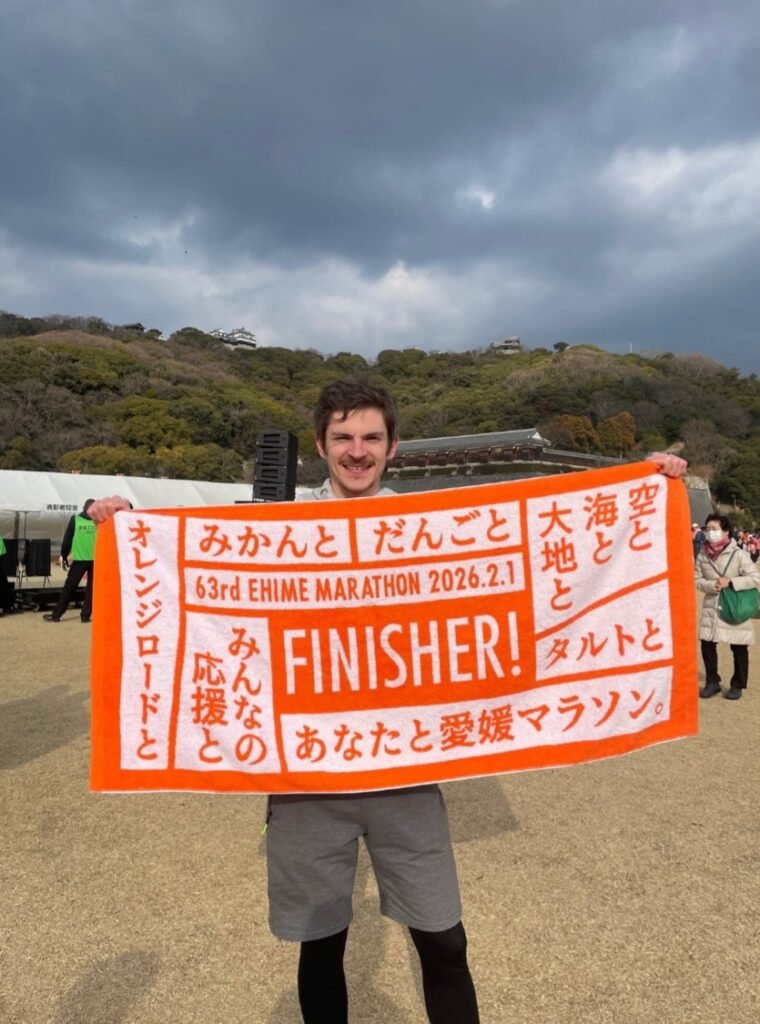
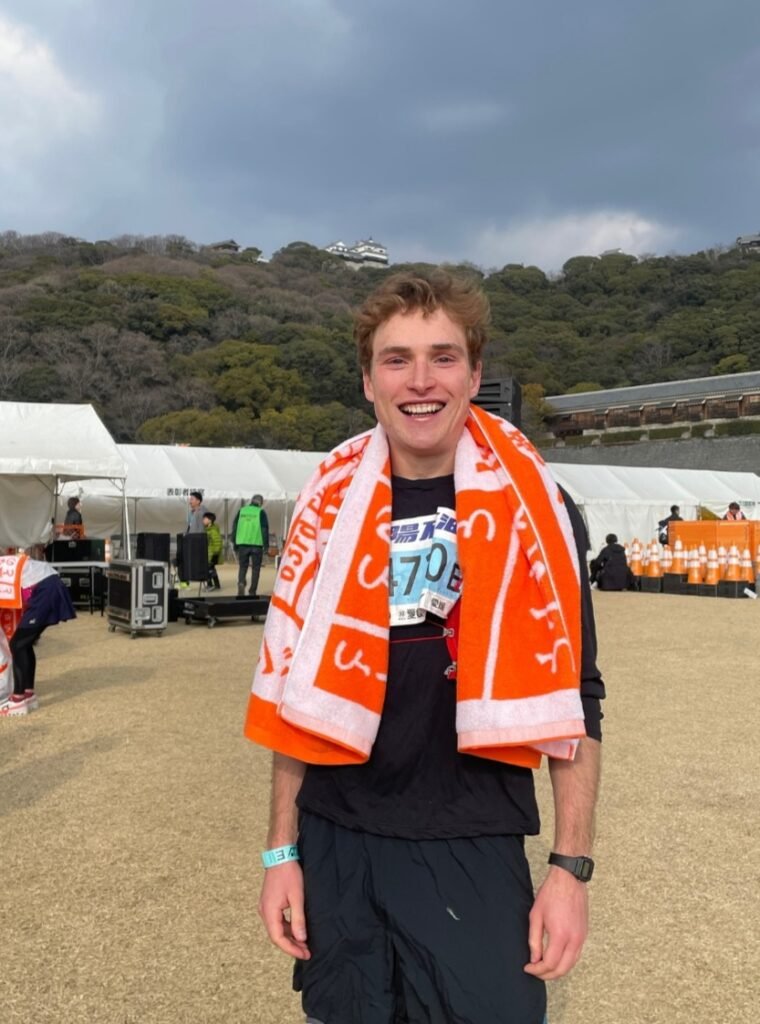
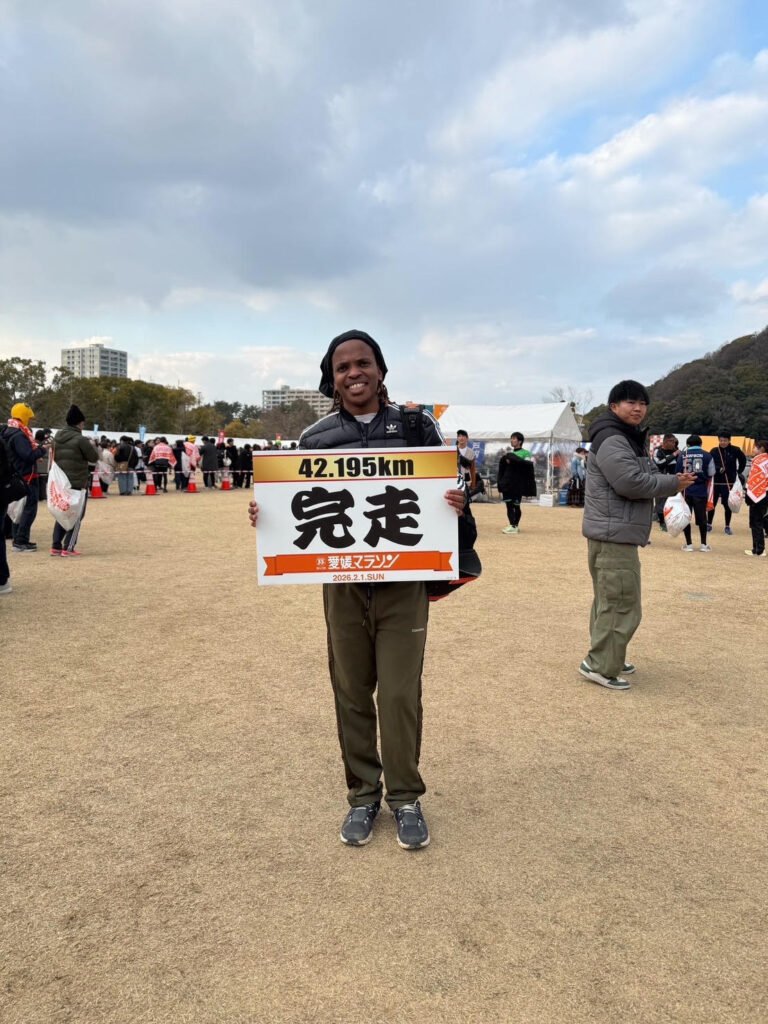
For non-runners like myself, the question naturally comes to mind: Why would anyone willingly sign up for this?
Their answers were surprisingly simple.
Topman joined because of an invitation.
“My supervisor asked if I could join him because he does it a lot, and I agreed because I wanted to see if I could run a marathon a second time in my life.”
Oscar was driven by curiosity.
“Everyone at the running club I attended last year did it the year I arrived, but I missed the sign-up. I’d never done one before, so I wanted to try it.”
James, already a regular runner, saw it as the next step.
“I’d heard about the Ehime marathon last year; it seemed like quite a notable local event than many people discussed, and I was pleased to hear that some ALTs had even ran it before! Running a marathon had always been an ambition of mine, having gotten into running as an excuse to get outside more during COVID-19, and the year before I came to Japan, I ran my first half-marathon around Victoria Park in London. I’d continued the habit here in Japan, running up and down the Ishite river every weekend, so it seemed natural that if I was going to elevate the habit into an achievement, then the Ehime marathon was the perfect opportunity; not just to run the length of a marathon, but to get involved in a big community event that I could talk to my Japanese colleagues and students to!”
Preparing for Something You’re Never Fully Ready For
Training looked different for each of them. Some followed gradual plans. Others simply tried to run more often and stay consistent.
Topman built up steadily.
“I started with running a 5k three times a week, and I slowly kept increasing it until it was 10k twice a week and a five once a week. Also, I joined Nanyo ALT running club. Each runner would post their runs, so that would keep me motivated to run.”
Oscar kept expectations intentionally low.
“Started very late but eventually, physically – I started to increase the amount I was running each week; mentally – I just went into it. I wanted to have fun and enjoy it, and tried not to put any unnecessary pressure on myself. I just wanted to finish. I didn’t set a time target.”
James discovered, slightly too late, that marathon preparation is its own science.
“Physically, I didn’t do much different from what I normally did – I continued my weekly runs up and down the Ishite river; a little over 10k from my house, to Ishite Temple, back down to Botchan stadium, and home again. In the 6 or 7 weeks immediately prior to the race, I started to increase my volume and distance; I’d run twice a week instead of once, pushing my distance on one day, and running a supplementary 10k the other. I got my distance pushing run up to 21k (about half of the real thing) before I started winding it back down again, trying not to overextend myself before race day. It wouldn’t take you very long after searching ‘marathon prep’ to find out this is NOWHERE NEAR the amount of preparation that running an effective marathon actually takes, even for someone relatively fit who runs consistently, and believe me I was well aware of this after I decided to search it for myself approximately a month and a half before the race. Finding out the recommended time to prepare for a marathon is about three to four months, building up to 30km runs, was a bit mentally shaking. But, after some time, I realized ultimately, I wasn’t racing anyone but myself, my only real goal was the finish line, and I knew I could make it. The only question was whether I’d be doing it on two legs, hopping on one, or crawling on four.”
That shift from competing to simply completing became a shared mindset.
When the Race Gets Real
At the starting line, nerves were inevitable.
Topman admitted,
“I was just cold and nervous, thinking if I would actually make it to the end on time for the cutoff time.”
Oscar worried about a last-minute injury.
“I decided stupidly to play squash for the first time exactly one week before the race, and sprained my knee slightly, so on the start line, I was worried whether it would hold. I was also late to the start line, so I missed my starting block and had to start right at the back.”
James, however, found reassurance in the atmosphere.
“Honestly, any anxiety I had about the race evaporated on the starting line. The weather was gorgeous, the energy was lively, and I was surrounded by people outfitted just like I was, of every age and build. Somewhere between the lean ultra-runners in skintight suits, the old women in golf caps chatting to one another, and the people dressed as Nintendo characters, I figured it was silly to think I was out of place. Physically, I was in as good a shape as I could be with 6 weeks of very lax training. I was absolutely loaded on carbohydrates from eating like a swarm of locusts for a week, and all the maths pointed to a challenging, but very doable, race. The people in my block inched out of the park, letting me catch one quick glimpse of some people there to support me with a giant cardboard cutout of my face, and I was off like a rocket.”
But every marathon eventually demands its toll.
Topman hit difficulty after the halfway.
“After the halfway line, I got a muscle pull, and that made my run hard. I had to massage it and walk, and then run a little. Also, I saw some people from my town who kept cheering me on, so it made me not quit and get on a bus.”
James encountered the infamous wall.
“Having only ever run as much as a half marathon before came back to bite me in a big way; I breezed through the first 21km in under two hours, a respectable time if I’d crossed the finish line then and there, but I had to do it all again on the way back, and it was around the 25km mark that I started to foresee problems. My energy levels were kept topped up thanks to some grape jelly I had on hand, as well as the snacks handed out seemingly every few hundred meters – water, energy drinks, bananas and oranges, even some Ehime staples like Ichiroku tart and Botchan dango – but my body was starting to give up. Notably, my feet were on fire from constantly hitting the tarmac, and the impact on my knees forced me to slow down considerably. Any attempt I made to change my form midway to compensate ran me more energy than it was worth, and my carefree jog became a sort of hurried shamble. I dipped in and out of a line of exhausted racers who walked alongside the runners, giving myself twenty, fifty, a hundred meters of respite at a time before forcing myself back into a run again. The last 10 kilometers may as well of been their own marathon at the speed it felt like I was going, and finally re-entering the city and seeing Matsuyama Castle on the hill didn’t make me feel any better; it may as well of been on the moon, it seemed so far away. Counting down the kilometers went from a coping strategy to a kind of Sisyphean curse as they seemed to go by an eternity at a time.”
Oscar’s knee injury thankfully didn’t get the best of him:
“The first 10km, when I was stressing about my knee (was when I started to feel the
challenge), after that I started to settle into it and gained confidence, so I started to speed up
a little and really enjoy it.”
What carried them forward was not just training. It was the people lining the streets.
“Seeing people from my town cheering me on made me not quit,”
Topman said. His competitive spirit also boosted his game:
“When I saw someone that I felt a few kilometers ago pass me, and I thought to myself, I need to pass them again.”
James shared a similar experience.
“The only things pushing me through were the students and volunteers lined up along the course, whom I made a point of high-fiving, screaming defiantly as I went, and the simple fact that by this point, it was too late to quit.”
The Moments That Stay With You
Ask marathoners what they remember, and it is rarely the distance. It is the moments.
Oscar recalled the atmosphere in Hojo.
“There was a band playing in Hojo, which was really cool to see, and an elderly lady handing out delicious strawberries. (I) don’t think she was officially anything to do with the race; she was just really kind. Seeing lots of familiar faces in the crowds along the way was also lovely, friends, life supporters, and teachers from my old school.”
James remembered seeing his principal mid-race.
“There were a dozen fleeting moments of interaction; people I knew calling out to me along the course, smiles shared with fellow racers, gratefully taking snacks from volunteers, and high-fiving the rows of students calling ‘Gambare! Gambare!’, so much it lost all meaning. One that sticks out the most was seeing my school principal! He went as far as to briefly join me for a 30-or-so-meter stretch as he wished me luck and shook my hand. I was too tired to say anything other than ‘Kocho sensei! Arigatou gozaimasu! Ashi ga itai! Gambarimasu!’, but it gave me enough encouragement to stay running for at least the remainder of that kilometer.”
Even their inner thoughts became survival tools.
“As long as my legs can move, I will keep going,” Topman told himself.
Oscar’s worrier-to-warrior mindset shift helped him push through.
“I love running, and the weather was perfect, so as soon as I stopped worrying about my knee, I had a great time; there was nothing I’d rather be doing at that moment.”
James described constant mental bargaining.
“Okay, so after this kilometer, we’re only two kilometers away from having three kilometers left until we’re at thirty-five kilometers, which is only seven-and-a-bit kilometers from the finish line…”
Perseverance, it turns out, is often practical rather than poetic.
The Finish Line, and Everything After
When they finally crossed the finish line, the emotions were refreshingly straightforward.
“Finally, I am finished,”
Topman said.
“(I felt) relief that I’d made it to the end and happiness that I saw lots of friends at the finish line. I really had a great time, especially the second half, so I felt good, but very hungry,” Oscar shared.
James laughed,
“’That wasn’t so bad!’ (I was high on a brief adrenaline rush from forcing myself to finish strong and run over the finish line).”
Recovery followed quickly. Finding somewhere to sit. Reuniting with friends. Soaking tired feet in a well-earned foot bath.
What Comes Next?
After such an experience, the natural question is: Would you do it again?
James joked,
“I think the only marathons I have in my immediate future involve a clear afternoon, snacks, and a drink, and multiple episodes of something, but hey! Don’t count me out next year!”
Oscar hopes to continue running and try another someday.
“(I hope to) Do another one at some point, and try to keep up with running more often.”
Topman, with all honesty (and humor?), said his goal is
“Not to agree to joining it if my supervisor asks me again.”
Advice for Future Runners
Their advice to anyone considering joining next year blends realism and encouragement.
James offered a reality check:
“Marathons are no joke. If you’re fit enough, finishing one is very achievable. Finishing it quickly? efficiently? with minimal pain? That’s what you’re training for. Take it seriously! Or live through the suffering.”
Oscar focused on mindset:
“Just do it, there’s nothing stopping you, and you will finish so long as you stay positive and try to enjoy the experience rather than stressing.”
Topman straightforwardly said:
“Just give it a try. You, unlike me, might enjoy it.”
In short: respect the distance, prepare for it properly, but don’t let it intimidate you out of trying.
In One Word
In One Word When asked to describe the experience in a single word, their answers said everything:
Topman: “Finisher”,
James: “頑張れ!!!”
Oscar: “Memorable”
More Than Just a Race
Beyond medals and finishing times, each runner walked away with something more personal.
Topman put it simply:
“Fifteen years between marathons is a long time, but the finish line – I must cross at all costs. I am a Finisher.”
Oscar discovered he genuinely loved the experience and wants to try again.
“(I realized) that I loved running a marathon, and I want to try and do it more often. Always thought I wouldn’t enjoy it as much as I did, and I usually enjoy running as a way to relax rather than compete.”
James reflected with humor:
“I learned that no amount of cardiovascular fitness is going to stop my bones from feeling like LEGO pieces shaking around in the box, and that no matter what I choose to do to myself, there’s always going to be people cheering for me, so thank you, everyone!”
And maybe that is what the Ehime Marathon really is.
Not just a race. Not just an athletic challenge. It becomes something shared.
By the time it was all over, costumes were crumpled, legs were wobbling, and more than a few runners were already saying, “もう二度と! (Mō nidoto! / Never again!).”
Some of them, of course, will probably sign up again next year.
Because somewhere between the start line nerves, the roadside strawberries, the high-fives, and that final step across the finish, the Ehime Marathon becomes less of a race and more of a story people want to tell again.
And from where I stood, holding a bobblehead in the winter air, it was a pretty good story to watch unfold.
Hey everyone! Thanks for checking out this month’s article. If there is a story, experience, or idea you’d like to share please reach out to us at themikanblog@gmail.com. We’d love to hear from you!
Best, Justin
