Last weekend I was invited to go on a tour of Uchiko to help promote it as a tourist destination. As a disclaimer, all expenses were paid for by the city, except for dinner at the German restaurant and the washi products I bought.
I was not really sure what to expect from the three-day Hojo festival. Leading up to the event I was told there would be fights, broken mikoshi, and a parade. Naturally, I was having a hard time imagining how all of this would fit together into one festival, especially one in Hojo. After all, when I arrived in Hojo for the first time, it gave me the impression of being a quiet, small town, similar to the one in the United States I grew up in. The only way to find out for sure how everything would come together was to go to the festival and witness everything for myself.
Four
year old me had many ideas about what I wanted for the future. Some included
wanting to be a paleontologist or astronaut, discovering new species of the
saurian or alien kind. Others were as mundane as wanting to be an ice cream
truck driver because I liked the music. That was before I discovered how creepy
that tinny music could be. Yikes.
One of the dreams that stuck around for longer (than my two week dream of selling ice cream, for example) was being a horse rider. Didn’t matter if it was as a rodeo rider, rancher, racer or jumper. I just wanted to ride horses. My aunt let me ride her horse a few times and my grandparents bought me cowgirl outfits when we went to see rodeo rides. My friends encouraged this by taking me riding for their birthday parties. Even if actually owning a horse or taking riding lessons wasn’t possible, I took every chance I could get to interact with horses.
So
you can imagine how excited I got when I was told that there would a horse
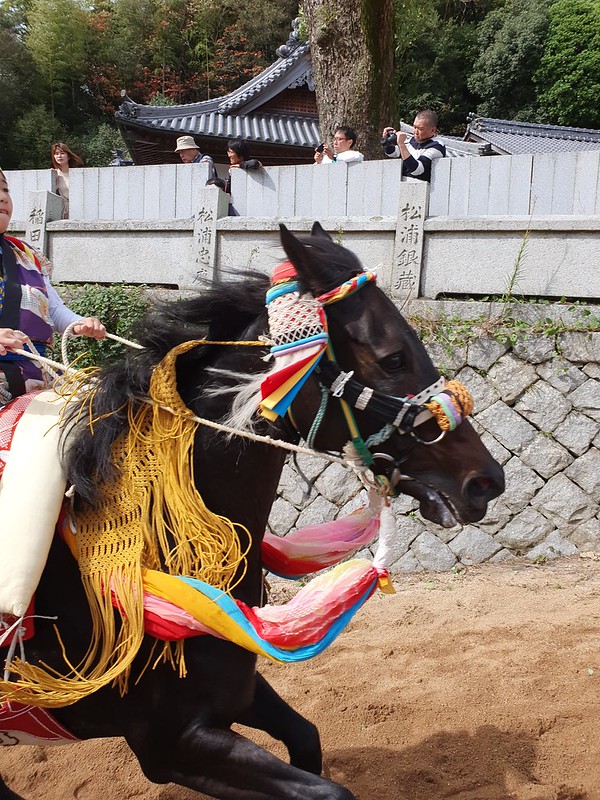
festival in Kikuma on October 20th.
Hey everyone! I’m Christian and I am from the small country of Trinidad and Tobago (/ˈtrɪnɪdæd … təˈbeɪɡoʊ/). For those who don’t know, it’s actually a country in the Caribbean archipelago that comprises of two main islands, Trinidad… and… you guessed it… Tobago. I hail from the larger sister island, Trinidad but from a very small, rural village called Manzanilla (a name of Spanish origins but the pronunciation has been anglicized). Trinidad and Tobago is fairly known in the Western hemisphere, however, halfway across the world in Japan, especially in a Prefecture such as Ehime, my country is barely known to the locals, or so it may seem.
A year ago, I was told that three of my five schools would be in the islands, and I would have to take the ferry or the kousoku, the express boat, to the islands and then find my way to school. That was how my journey to Nakajima and Nuwajima began.
Every three years, a contemporary art festival draws thousands of Japanese tourists and foreign visitors into the sparsely populated islands resting in the sea between Honshu and Shikoku. The Setouchi Triennale, also known as the Setouchi International Art Festival, began just nine years ago in 2010, but it has already garnered acclaim as a top destination in the contemporary art world and as one of the most unique events to take place in Japan. Whether you’re an art lover or an island adventurer (or both!), the Setouchi Triennale offers something for every kind of Shikoku explorer. As JETs in Ehime, we are extremely lucky that the Setouchi Triennale happens in our backyard. Here’s a short guide to the festival, general background and visiting information, and a brief snippet on one of my favorite islands of the area.
Last summer I had the opportunity to be invited to an all-expenses-paid trip to the coast of Ainan to test a promotion by their tourist board. The trip promised a boat ride out to a nearby island, some underwater sightseeing, and a class held by a local artisan. All I needed to bring was a swimsuit, ¥1,000 for lunch, and a willingness to smile in the group photos.
I honestly did not think that the trip would happen. It had already been postponed once, due to it being ‘a little windy,’ and the weekend of the postponement date was approaching in lock step with not one, but two typhoons. Luckily, I did not schedule anything for that day except a Netflix marathon, so when the call came through that it was time to pack my bags and head down to Ehime’s southernmost town, I was eager to do so.
I remember when I first came to Japan and
heard stories of wild and crazy things that would happen to JETs; unexpected
adventures that would happen or strange gifts that they were given just for the
fact that they were one of the sole representatives of a different nation in
their town. They were the kinds of stories that were hard to believe because
they sounded so extreme, so they must be rare or non-existent.
I woke up this Christmas Eve with a new anticipation. Instead of performing the traditional caroling and cookie decorating with my family, back in America, I would be traveling to Matsuyama Castle as a Samurai.